The Nigerian tech ecosystem is often described as the Silicon Valley of Africa. From the bustling hubs of Yaba to the rising tech corridors in Abuja, the narrative is usually one of unbridled triumph, unicorns being born, massive seed rounds being raised, and a generation of young Nigerians coding their way out of economic instability. It is a beautiful story on paper. However, as someone who has spent years in the trenches of web development and IT, and even more time as a founder trying to build sustainable solutions on home soil, I’ve realized there is a rot beneath the surface that no one wants to talk about.
We talk incessantly about global rates and dollar-equivalent salaries, but we have conveniently silenced the conversation regarding global standards of delivery, accountability, and professional ethics. As the CEO of Fele Express LTD and a veteran in the tech space, I’ve seen the ecosystem from both sides. I’ve seen the brilliance, but more frequently lately, I’ve seen a culture of paycheck-first development that is systematically sabotaging the very founders trying to build the future of the continent.
To understand the current tension between founders and developers, you have to look at how we got here. Nigeria’s tech scene exploded because of a genuine need for local solutions, logistics, fintech, and e-commerce. We have the talent; I’ve met young guys who can re-engineer their own cache and optimize an OS from scratch. But somewhere along the line, the pursuit of craft was replaced by the pursuit of the “big bag.” The rise of remote work for international firms created a skewed reality where local developers began demanding Silicon Valley rates for what is often, unfortunately, subpar local output.
The argument usually goes: “If a developer in London earns $80k, why shouldn’t I?” My answer is simple: The developer in London is part of an ecosystem governed by extreme accountability and a value-first mindset. In Nigeria, we are increasingly seeing a trend where developers view founders not as partners in innovation, but as ATM machines to be milked for as long as the dev-speak can keep them confused.
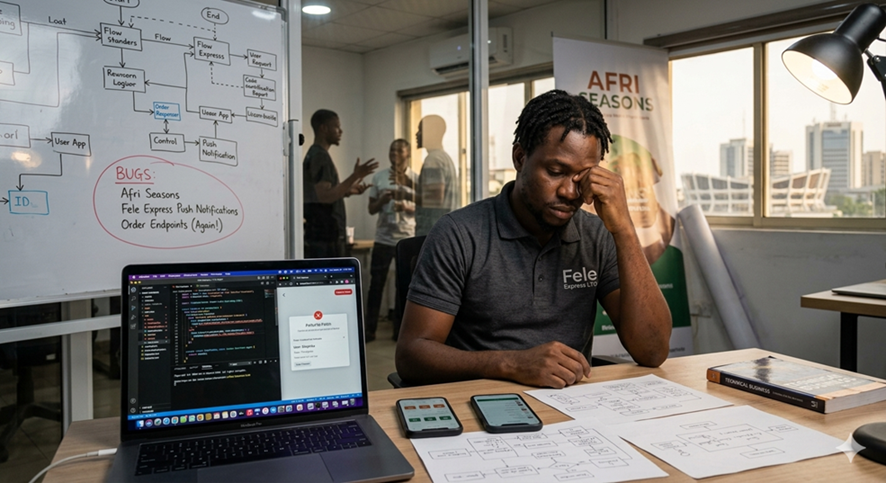
I speak from a place of deep, expensive scars. I have had two major platforms, apps I poured my heart, soul, and significant capital into sabotaged by Nigerian developers who valued the paycheck more than the product. The first was Afri Seasons. It was a project with immense potential, designed to bridge gaps and create real utility. It died, not because the market wasn’t ready or the business model was flawed, but because the technical foundation was a house of cards built by people who simply didn’t care if the roof leaked as long as they got paid for the bricks.
Now, I find myself in a similar battle with Fele Express LTD. We are in our third year, and we have invested over 10 million Naira into our mobile application. For that amount of money, a founder should expect a seamless, world-class user experience. Instead, I am still waking up to basic, amateurish technical debt. We are struggling with broken push notifications, incorrect order endpoints, and empty UIs that shouldn’t exist past the MVP stage. I cannot have a customer use the app for two minutes without a bug report flying in.
When you confront the developers responsible, the response is rarely a commitment to excellence; it is usually a request for more money to fix the very things they were paid to build correctly the first time. I’ve seen quotes of 500,000 Naira to fix a single notification bug. It is a joke that isn’t funny.
Contrast this with the global market. You can find an Indian developer who will build a sleek, functional MVP for a fraction of that cost, but with a crucial difference: they offer to take dividend payments once the app starts generating revenue. That is the definition of value-driven engineering. They are willing to bet on their own code. They aren’t just looking for a one-time “hustle”; they are looking to build a legacy.
The problem with the Nigerian tech saga isn’t that founders are stingy or that the diaspora doesn’t understand the global rate. The problem is that we have a talent pool that wants the reward of a marathon runner while only being willing to walk a few yards. We have engineers who are more focused on their Twitter (X) brand and their “senior dev” titles than they are on the actual stability of the endpoints they deploy.
If this trend continues, Fele Express will just be another name on the long list of Nigerian startups killed by technical sabotage. Founders will stop looking inward. We will take our capital to India, Eastern Europe, or Vietnam, not because we don’t love our country, but because a business cannot survive on patriotism and buggy code.
To the Nigerian developers reading this: excellence is not a global rate. Excellence is an obsession with the quality of what you ship. If you want to be paid like the best in the world, you must be prepared to be held accountable like the best in the world. Until we bridge this value gap, the Nigerian tech dream will remain just that a dream constantly interrupted by another System Error.